ANNOUNCEMENT: We are moving FEMigration to Substack soon. Until the transition is complete, we will be crossposting on both platforms. Please take a moment to sign up for a free subscription at FEMigration.substack.com
by Joanne Tica
Before the Second World War, my father’s future had already been planned for him. Born in a village named Golubić, near the city of Knin, in what is now Croatia, his origins were very humble. The family farmed and sold their agricultural yields for a living. They sold their labor to urban companies during the winter months. It was subsistence living, at best. His ancestors had lived in the same village since the 1400s doing the same thing as the modern-day inhabitants of the family. My father’s grandfather, my great-grandfather, decided that my father, his eldest grandson, would be the one to break that pattern.
My great-grandfather used whatever influence he had to secure a position for his grandson, my father, to attend military school in Belgrade. The expectation was that he would finish his education and then serve in the King’s army as a career military officer. In my late father’s words, “I didn’t want to be a farmer. I wanted something better for myself and my family.” He wanted to see the world and looked forward to leaving Golubić, which had a direct train to Belgrade, where he saw his future.
The war changed that dream. The Kingdom of Yugoslavia was invaded in 1941, when my father was sixteen years old and about to embark on his future. The Serbian communities in the Krajina region were subjected to violence and persecution under the Ustaša regime. My father joined the Cetniks, which he saw as a way to protect his family and their established way of life. Although he was proud to be a Cetnik, it was a time in his life that he did not speak of too much. I always thought it was because it was a painful period in his life that brought back many uncomfortable memories.
The last time he saw Golubić, he was escaping from the same train station that was supposed to take him to his future life in Belgrade before the war started. The Cetnik battalion of which he was a part was trapped in the basement of the Golubić train station for fifteen days while surrounded by Ustaše snipers. It was only because of the heavy rains and flooding that most were able to escape that basement and begin a journey of displacement and migration that would last for five years before embarking on a new life in the United States.
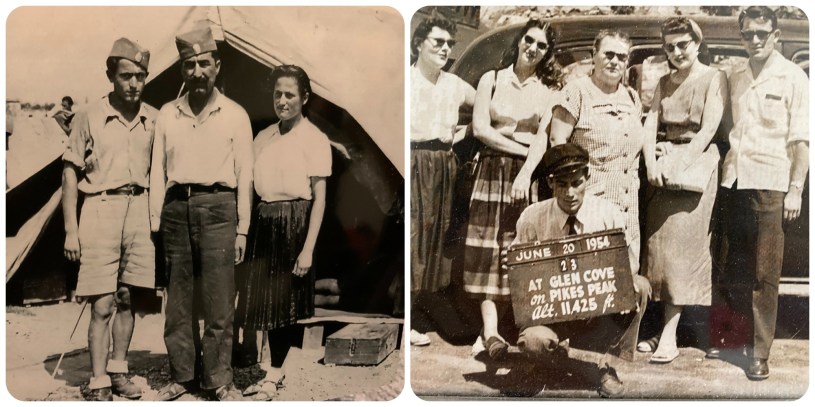
Along with my father, my grandfather, my aunt, and my father’s best friend (who would later marry his sister) left their home for the final time after that train station standoff. They walked to Italy with other Serbian refugees, where they spent time in a displaced persons camp, then transferred to a more stable DP camp in Germany to wait. His mother remained in Golubić, left to raise his five younger siblings alone with the support of his next youngest brother.
My father never saw his mother again. His last memory of her was watching her wave goodbye to him while holding my uncle, who was literally a baby when my father left. My father often spoke about his mother lovingly. The household in which he grew up was very patriarchal, but she had a big influence on his life. He was the eldest son and occupied a special place in the family, so she made sure that he was treated well. She took great pride in his intellect, perhaps because she herself was barely educated. He said she believed in the future that had been planned for him before the war changed everything. He loved her deeply as her eldest son and felt protective of her, a physically tiny woman whom he wanted to make proud.
Eventually, in 1950, my father was resettled in the United States, traveling by himself through Ellis Island and landing first in Pittsburgh, PA, then Akron, OH, and then finally in Gary, IN. His refugee documents show that he was supposed to have been settled in Chicago, on Schiller Ave, but that didn’t happen. He ended up in Gary because his father, sister and her husband and two children wanted to be together, to retain whatever family they still had in the new place they now called home.
He met my mother after watching her performing on stage, giving her rendition of Kosovska Devojka (The Maiden of Kosovo). He said, out loud, that he had to meet that girl, not knowing that he was sitting next to her mother in the audience. Needless to say, he didn’t make a good first impression on his future mother-in-law. Years later, after he married my mother, who was a second-generation Serbian American, he sent his own mother an album of their wedding photographs.
I had always known that story of the album. It took on a different meaning after I recently visited Golubić and saw the place where my father was born and raised. His beginnings were very humble. The wedding photos depicted a life that was settled and full, similar to what he had built for himself after arriving in the United States. It was, however, so far removed from what life in Golubić was like, especially after the war. I could only imagine what those wedding photographs must have looked like to his mother. The clothes, the celebration, and the setting probably seemed surreal to my grandmother.
My father always said that the wedding would show her that he was fine. Sending her those photos were his way of including her in his special day. He wanted her to see that her eldest son had survived the war, survived years of displacement, and had built a good life.
She died not long after receiving that album. I sometimes think that knowing they were all OK and were trying to reunite the family made it easier for her to quit fighting the good fight and rest. That’s what I like to think, at least.
For most of my life, I knew these facts as separate parts of my father’s life history. I knew scattered facts about Golubić, the war, the displaced persons camps, his Cetnik identity, and the mother he never saw again. What I understood less clearly was how much of the person he became had already been formed by his experiences before he ever left.
We are not separate from the people and experiences who raise us. We are shaped by what they teach us, what they expect from us, what they value, and the way they see us when we are still becoming ourselves. Migration can move a person thousands of miles and place them in a completely different life, but it does not erase those early influences. That has occupied my thoughts since I returned from our family trip to Golubić.
My father built a good life in the United States. He married, raised a family, worked hard, had good friends, and created a future that was very different from the one his grandfather had planned for him. But the person who built that life was still shaped by the boy who had grown up in Golubić, and by the people who had been part of his life there. He wanted his mother to know that he was OK.
The wedding album story has stayed with me because it captures that idea so simply. My father wanted his mother to see the life he had made for himself. He wanted her to know that the son she had raised had survived and was doing well. His life in the United States did not replace the life that came before it. Both lives were part of him and always would be. That also meant that both his mother, and Golubić, would always be a part of his story, and of ours too.
Have a good story that you’d like to share on this site? Contact us at femigration.blog@gmail.com


I cried more than once reading this account of his journeys, inspired, I think, by your visit. Just beautiful. It’s another one I’d like to print one day. Very, very touching. What do I have to do to make sure I don’t miss anything as you transition/cross post. Your stories make me stop and read, something I don’t do often enough anymore.
>
LikeLike