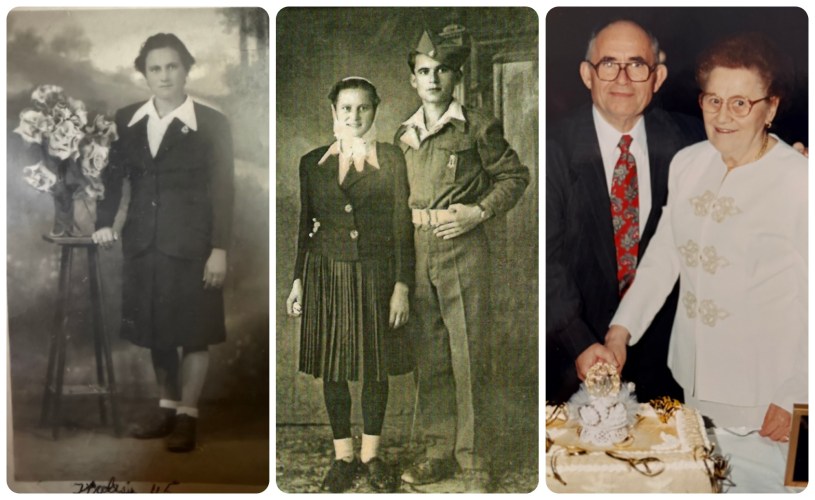

Andjelija “Andja” Djukic was born in Golubic, a village near Knin in the Dalmatian region of what was then Yugoslavia. Her family remembered the snowstorm that marked her birth more clearly than the date itself. For much of her life, she believed she had been born a year later than she was. Only decades afterward, when her younger brother, Jovo, returned from a trip abroad with her birth certificate, was the record corrected. She had been born on February 16, 1922.
She was the oldest of seven children, though even that position carried uncertainty. An older sister, Jovanka, had died in infancy. Because of that loss, Andja was not given a family name at birth. The family feared using another family name for a child who might not survive. She became the only child in the family who did not carry a historically significant name for that reason. From the beginning, caution shaped how she was placed within the family.
She grew up in a household organized around work and routine. The family lived above their animals in a stone house with no running water and a wood-burning stove providing heat and fuel for cooking. All the children slept together in one room. The Tica family had lived in Golubic for centuries, and daily life followed a pattern that was stable and demanding. They farmed their land, raised sheep, and sold wool and produce in Knin. During the winter months, the men traveled to nearby villages and cities to find work. This way of living was not described as hardship. It was simply the structure people lived within.
As the oldest child, Andja assumed responsibility early. By the time she was eight or nine, she was taking the sheep into the mountains each day to graze. As more children were born into the family, she helped care for them alongside her other work. Her grandmother oversaw the household, while everyone else worked the land. Decisions moved downward through the family hierarchy. Children did not expect choice, and girls did not expect to direct the course of their own lives. By the time Andja reached adolescence, the boundaries of her life had already been set by others. A future spouse had already been selected for her, whom she later refused in an act of defiance that was not typical of women in her generation.
Schooling followed the same pattern of limits. Children attended a one-room schoolhouse when the agricultural calendar allowed it. Girls went through the fourth grade, while boys continued through the sixth. Discipline was strict, and schooling stopped entirely during planting and harvest seasons. Andja learned to read and write, and she valued that education, but she also understood that it would not carry her beyond the life already planned for her.
As she grew older, she became aware that other ways of living existed. On market days in Knin, she noticed that people with trades lived differently from those dependent entirely on farming. Tradespeople and skilled workers were able to work closer to home and had steadier work. She asked her parents if she could go to school to learn the trade of tailoring. As was typical, the request was passed to her grandfather, Vasilj, who held authority over such decisions. He refused to allow her to pursue this path. He believed that girls did not need those skills. The answer was final. While she lived in her family home, her future was not something she could negotiate.
Church structured the rest of the family’s social life. Weekly services, holidays, weddings, funerals, and Patron Saint Day celebrations (Slavas) shaped the rhythm of the year. Faith provided continuity and order in a world where expectations were fixed, and daily life followed long-established patterns. For a very long time, that structure held.
It ended in 1941.
As Yugoslavia began to collapse and Italy occupied Dalmatia, the familiar order dissolved. At first, the war felt distant. Italian soldiers fed children and did not appear openly cruel. But alliances shifted, violence spread, and it became dangerous to remain in place. The structure that had governed Andja’s life did not transform into something new. It disappeared.
In June 1941, Andja left Golubic with her father and her brother Ilija. Traveling with them was Milan, Ilija’s close friend, who would later become Andja’s husband. They moved together, as a unit. Andja joined other women supporting the fighters (while sometimes fighting herself) by cooking, carrying supplies, and caring for the wounded. Like many others, she believed the separation from home would be temporary.
Movement became constant. They slept wherever shelter was available, sometimes in houses, sometimes in fields or protected wooded areas. They returned to Golubic when conditions allowed, but never for long. The fighting was not primarily against Nazi forces but against Partisans, in a civil war that divided communities and made safety unpredictable. Life narrowed to decisions about where to go next and how to stay alive.
During one escape, Andja was running with her closest friend when gunfire erupted behind them. Her friend was shot and fell. Andja paused briefly and then continued running. She understood that stopping would likely mean her own death as well. She survived. Her friend did not. That moment stayed with her, not as a story to be repeated, but as a haunting fact she carried forward.
When the war ended, it did not restore what had been lost. Chetniks were designated as war criminals by the country that they gave their lives to protect. Regime change caused their citizenship to be revoked and returning to their homes and families was no longer possible. They left Yugoslavia in a walking caravan and eventually reached Italy. Andja crossed into Italy with her family and was sent to a refugee camp on the coast. What had once been movement had now became waiting for what was next. The future was unknown.
Life in the camps was limited and uncertain. Families lived in tents and makeshift facilities, relied on rations, and waited for decisions that governed them from afar. What was meant to be temporary became the setting where daily life took place. Andja married Milan in the camp at a group wedding held under very basic conditions. Their first child was born in a tent in Eboli, Italy. Their second child was born later, in another refugee camp in Germany. For nearly five years, Andja lived life and raised babies in places designed for containment rather than settlement, where permanence was not assumed.
By the time authorization to leave Europe was granted to the Djukic/Tica refugees, the camps had become the only stable life Andja’s family had known in quite a few years. Leaving the protected environment and its associated community did not feel like departure so much as another crossing, again without the expectation of return. The family, including her father and brother, had received permission to travel to the United States due to the generous sponsorship of the Serbian Orthodox Church. After a long journey by boat, they were processed at Ellis Island in New York City and were eventually resettled in Gary, Indiana.
Life in the United States required many adjustments, but it also introduced stability that had been unattainable for years. With this stability came profound loss. She never saw her mother again. Andja learned to speak English, learned to drive, and worked outside the home. She raised her children in an industrial city far removed from the village where she had grown up. For the first time, daily life followed a predictable rhythm. Work, school, errands, and routines replaced the constant uncertainty that had defined her earlier years.
Over time, her life took on the outward shape of an ordinary American one. She moved somewhat comfortably through daily tasks and public spaces. She navigated institutions, when necessary, built relationships, and handled responsibilities without drawing attention to herself. Eventually, to those who did not know her history, there was little in her manner or presence, except for her accent, that suggested war, displacement, or years spent in refugee camps.
She remained an immigrant and a refugee by experience, but those experiences were no longer highly visible on the surface of her life. She did not speak often about what she had lived through, and she did not carry herself as someone marked by loss. What people saw instead was steadiness, confidence, and a direct way of engaging with the world. This was not a failure to remember the past, but a way of living beyond it.
Neither Andja nor Milan stepped away from their commitment to the Chetnik community. Throughout their lives, they remained active leaders in the organization, preserving memory and honoring the sacrifices of those who had fought and died to protect their country and their way of life. This commitment existed alongside their daily lives rather than apart from them. It was one of the ways they carried their history forward without allowing it to define every moment.
Northwest Indiana became the place where life continued. It was where she worked, raised her three children, stayed active in her faith, and remained connected to the community she and Milan had brought with them. The past did not disappear there, but it no longer determined the shape of each day.
Her life demonstrates something that has not changed with time. People leave not because they want to, but because staying is no longer possible. No one leaves home hoping to lose family, language, or familiarity. They leave because circumstances force a choice they did not seek. What follows is not a single moment of arrival, but a long process of rebuilding, normalization, and ordinary living.
Andja’s life belongs to that longer history, shared by people before her and by those still moving today, carrying what they can and building life where they land.
This article was written by Joanne Tica based on information provided by Milena Djukic, Andja and Milan’s daughter. If you, one of your relatives, or a friend has a story that you’d like to place in print on Femigration, please contact us at femigration.blog@gmail.com
 FEMigration
I thoroughly enjoyed this recounting of +Andja’s life. The struggle that our people who lived in the former Yugoslavia was incredibly harsh and as evidenced by so many who resettled here, forged a life of success and purpose. Thanks to you for sharing her story. It deserved to be recorded for all to read as an example of the strength of our people.
LikeLike
Thank you for your feedback, Martha. We hope that you’ll stay tuned for more!
LikeLike
Thank you. Please may I suggest you establish a Femigration Substack and post works like this one there. A wider audience and you may get more submissions if you solicit them.
Andji’s story is very much like my Serbian father’s story. A soldier, he became a prisoner of war in 1941. Not a Chetnik though. Spent 1945-50 in refugee camps. I did not know his citizenship had been revoked.
Keep going! There are so many immigrant women of all nationalities with stories.
Catherine
Catherine Rankovic clrankov@gmail.com AureliaPlath.blogspot.com
LikeLike
Catherine – That is a great suggestion and I’ll look into that. I agree that it is a better platform for a blog like this. We appreciate your feedback and agree that are many more stories to be heard. Take care and thank you.
LikeLike